·11 min read
SEO pre-sales with AI at SEOloger #81
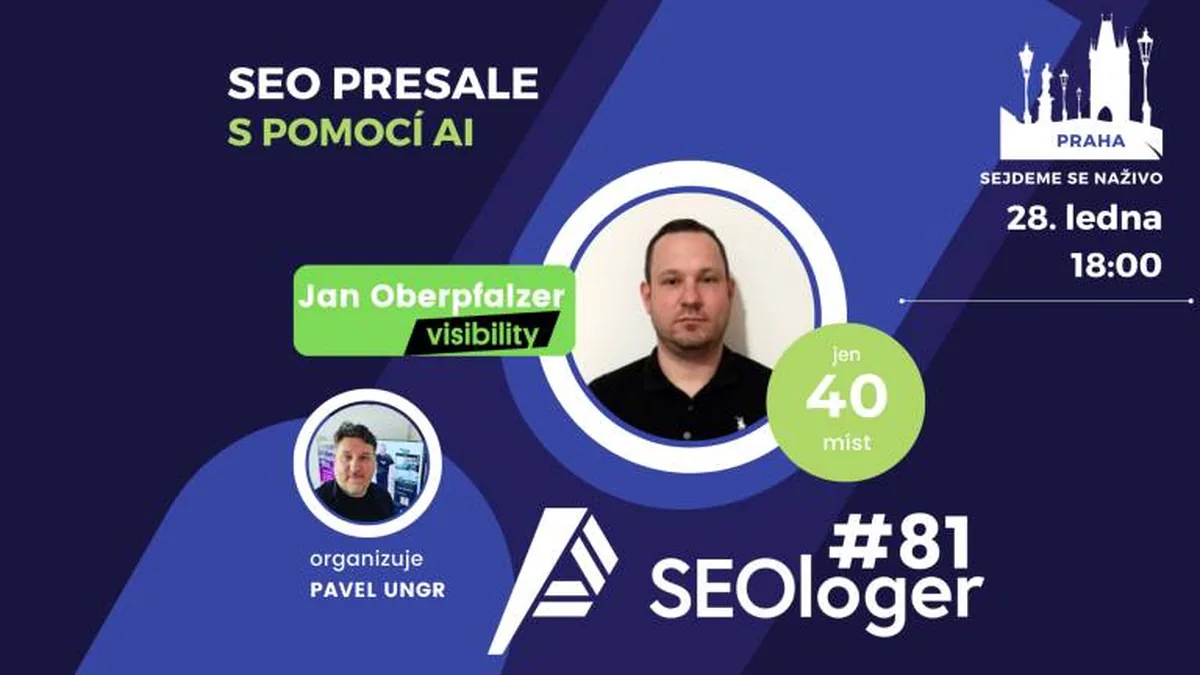
It has been a while since January 28, 2025, when I spoke for the first time at SEOloger #81 at the ČTK Press Center in Prague. My talk was about SEO pre-sales using AI, and I showed a simple workflow built on a custom GPT. At the time, it made sense to me mainly because it could sort inputs faster and prepare a first working view of a project.
Not even two years have passed since then, yet today it feels like opening the same presentation in a completely different technological era. When I gave the talk, Czech Google users didn’t have Google AI Overviews yet.
Since then, I have been working with my own skills, MCP servers, AI agents, advanced scraping and SEO tools I build myself. It is no longer just one custom GPT working on exports and screenshots. I have built a system that shortens the path from data to a first sensible hypothesis.
That is exactly why I am only publishing this article now. Not as a guide to be repeated unchanged, but as a record of the shift that has happened in SEO in a very short time.
The principle stays the same. AI speeds up collecting, sorting and preparation. But what is really holding a website’s performance back, what has priority and what has business impact is still decided by a person.
Why did I choose this topic back then?
I didn’t want to show another demo of what a customized GPT can do. I was interested in a more practical question. How do you quickly get a first sensible picture of a website during SEO pre-sales, when you don’t yet have access to analytics or Google Search Console?
As Head of SEO at the Visibility agency, I dealt with this repeatedly when onboarding new clients. At the first sales meeting, I needed to show that I understood the project’s situation, could name the main questions and knew what needed to happen next.

What should SEO pre-sales deliver when I have no data?
In the pre-sales phase, I often have no access to GA4, Google Search Console or other internal data. Even so, I need to find out whether the website is running into a technical problem, weak content, an indexing problem, low authority, low organic traffic or stronger competition.
A first view like this is not a finished diagnosis. It is a working basis for further discussion and broader thinking. Publicly available data helps me find the areas worth focusing on later. Only once I have access to the client’s accounts can I check whether the first findings hold up on real data.
That is why SEO pre-sales is not a shortened SEO audit or a boring list of recommendations. It should show whether there is a concrete reason to go into a deeper analysis and what work could follow on from it. That could be a technical audit, keyword analysis, content gap analysis or another specialized analysis depending on the project’s situation.
How I put together a first view of a project
I don’t go after the largest possible number of SEO metrics, which can be misleading. I look for whether the same problem shows up from several angles. If the crawl, the speed measurement and the competitor comparison all point to it, that is a reason to pay attention to it. One isolated metric is not enough for a recommendation.
The first view of a website is built on these sources.
- a website crawl in Screaming Frog (technical health, indexing, internal linking and errors repeated across templates)
- speed measurement via the PageSpeed Insights API on important URLs and page types
- organic visibility, search engine rankings, AI visibility
- link profile and domain authority compared with the main competitors
- a competitor comparison by shared clusters, keywords and important landing pages
When I don’t have a project set up in Collabim or Marketing Miner, I use Ahrefs, Semrush and other popular SEO tools to compare competitors. I don’t take their outputs as the truth. They are still only indicators for questions I need to verify myself in the next phase. The data only makes sense once I connect it with the website’s technical health, the analytics and the client’s business goals.
Screaming Frog crawl via an MCP server
For me, the Screaming Frog crawl is the starting point for an overall technical view of the website’s current state. I run it through a connected MCP server. Within moments, it shows me broken URLs, unsuitable redirects and the site’s indexing problems, finds duplicates, highlights weak spots, audits internal linking or points to errors repeated across templates.
But I never start by sending the client a plain list of warnings that tell them nothing. I look for patterns, whether problems repeat and hit important landing pages, resulting in low visibility or conversions. Five hundred minor errors may mean nothing. One badly configured template or one wrong line in robots.txt can mean a far bigger problem.
Checking website loading speed
By connecting Screaming Frog with the PageSpeed Insights API, I can compare the loading speed of a larger number of important URLs. That way, I don’t just see one weak sample from one URL, but also whether the same problem repeats across many categories, products or other important pages of the client’s site.
In pre-sales, I am not interested in the score alone. I need to understand what slows the page down, which metrics are problematic, whether it is linked to the template and whether the problem may be hurting the user experience in places where the website should be winning traffic or orders.
Why do I bring AI into this?
When I prepare an SEO pre-sales pitch, I already have a lot of data available. The hardest part is rarely getting the data. The hardest part is quickly recognizing which of it deserves attention.
How do I work today?
I work with skills, MCP servers, AI agents and my own SEO tools, which pass clearly defined tasks between them. One step prepares the inputs, the next looks for repeating patterns, and at the end I look at what in them really relates to the specific project.
What changes is how fast I get from messy inputs to a first sensible question. Instead of going through every export by hand, I can sooner work on why a particular problem arises, where it repeats and whether it deserves priority.
That is where AI saves me the most time. Not by writing the presentation for me, but by freeing up room to verify my own findings that I can show the client.
What needs stressing
The biggest risk of working with AI is not that it misunderstands the brief and the context. The risk is that it produces clear, convincing output that a person may trust before checking the source data. That is why I never send AI output to a client without checking it myself.
This is exactly the difference between a tool export and a senior human view. One problem can look dramatic in a report but in reality concern a page with no traffic and no business value. AI only helps me find the places I should look at personally.
How to approach different types of projects
The same finding doesn’t mean the same priority on every website.
With a large online store, I therefore first look at filtering, robots.txt, hreflang, category templates, duplicates, content elements and other things that can replicate across the whole website.
With a content site, I look at whether the website covers the important topics, links them together and has strong enough landing pages for them.
A smaller business website, on the other hand, often needs to sort out its offer, credibility and basic visibility before it starts dealing with complex technical details.
Charts in a presentation are not just decoration
I only put charts into a pre-sales pitch when they make important decisions easier. If I have to explain a chart for two minutes, it doesn’t belong in the presentation. The client should understand from it within moments where the problem is, how big it might be and why I am paying attention to it.
I don’t want to swamp the client with metrics just because the tool can display them. At the start of the presentation, I need to show the main connection, the possible business impact and the direction of further work. One good chart with a concrete finding does more than ten tables.
A typical example is the competitor comparison. When a competitor covers more relevant topics, has a stronger link profile or a much better estimated visibility, a chart shows the difference faster than several minutes of explanation. The same works for performance over time or the loading speed of important page types.
At the same time, I always tell the client what the chart doesn’t show. Figures from external SEO tools are only estimates, not their company’s internal data.
How findings become a concrete SEO pre-sales pitch
A bad pre-sales pitch contains lots of findings, but after reading it the client doesn’t know what to tackle first. It is not a contest in counting errors. It is about naming a few things that may really be holding the website back and explaining why they matter.
The pre-sales pitch then produces not just a list of tasks without priorities, but a proposal for further work several months ahead. Sometimes it makes sense to start with a technical audit, other times with keyword analysis or with changes to important pages. An SEO roadmap is never finished once and for all. It changes over time with results, the client’s commercial offer, market developments, competition and seasonality.
A pre-sales pitch must be concrete and targeted
In the talk, I showed problems that recur on websites. For example, a weak category structure, missing content, poor indexing, insufficient internal linking, slow loading on mobile and desktop, or low domain authority. But that doesn’t tell the client what to do.
The client must understand that I understand their current situation, business goals and obstacles. It isn’t enough to show them what my SEO tools can do. They want to hear what we will actually do, why it matters and what the next steps should be.
Who should present the pre-sales pitch
The final pre-sales pitch should be presented by the SEO specialist who prepared it. They know the data sources, which conclusions are verified and where they are still working with their own hypothesis. That lets them answer the client’s tough questions concretely and without promises the data doesn’t yet support.
An in-person presentation to the client or a scheduled Google Meet has one more big advantage. The client fills in information you won’t find in the data. They tell you their business goals, specify the marketing budget, reveal their development team’s capacity, mention the months of the year when they do best, and so on. After that, preparing the next SEO strategy is a pleasure.
Who deserves thanks
Many thanks to Pavel Ungr for the chance to speak at SEOloger in Prague for the first time. If you want to move forward in SEO, I can recommend his SEO training courses. I have attended many of them in person.
Big thanks also go to the Collabim team, who partnered the event and dedicated an article of their own to SEOloger #81. I have long used Collabim for work with rankings, analyses and other SEO data. I use its MCP server in real work on my clients’ projects.
Thank you for reading all the way to the end.
Honza
Want to know what is holding your website’s performance back?
I’ll go through the technical health, the content and the competition, and tell you where it makes sense to start.